Vice President Honors 52 BECE Awardees

Date:


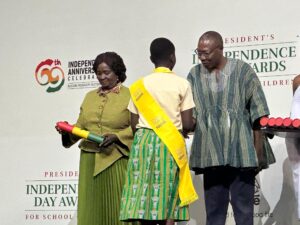
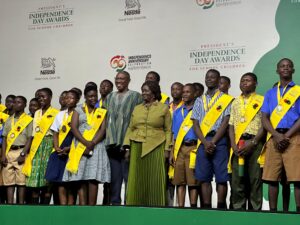
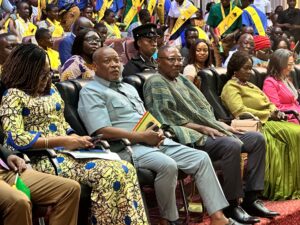
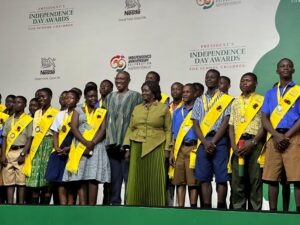
The Vice President, Professor Jane Naana Opoku-Agyemang, has honored 52 outstanding BECE awardees at the 69th Presidential Awards Ceremony, celebrating academic excellence while urging discipline, integrity and responsible conduct among Ghana’s youth.
Speaking at the prestigious President’s Independence Day Awards ceremony, held to recognize the top performers in the Basic Education Certificate Examination (BECE), the Vice President described the award scheme as a reflection of Ghana’s enduring commitment to dedication, discipline and faith in the potential of its children.
“This award scheme demonstrates what we, as Ghanaians, value in our education — dedication to learning, respect for excellence, and faith in our children’s potential,” she stated.
This year’s ceremony recognized 52 exceptional students drawn from public and private schools across all 16 regions of Ghana, including visually and hearing-impaired students. The Vice President gave special recognition to students with disabilities, stressing that national development must be inclusive.
“As a nation, our duty is to ensure that every child, no matter their ability or background, has the opportunity to learn, grow and succeed,” she emphasized.
While celebrating academic success, Professor Opoku-Agyemang used the platform to address growing concerns about indiscipline in some schools, including vandalism and disrespect toward authorities. Read Also: STNFL Founder Petitions Chief Justice Over Alleged Judicial Irregularities
She noted that although only a small minority of students engage in such behavior, their actions risk undermining national progress and damaging Ghana’s reputation.
In response, she announced that the Ministry of Education, through the Ghana Education Service (GES), is strengthening discipline frameworks, reinforcing guidance and counseling systems, and reviewing school disciplinary measures where necessary.
“The goal is not punishment for its own sake, but to develop citizens who understand both their freedoms and responsibilities,” she explained.
She urged the awardees to remain focused as they transition to senior high school, cautioning them to choose friends wisely, respect authority, and uphold moral values.
“Excellence is not only about academic performance. It is also about how you behave when nobody is watching,” she said.
Referencing this year’s Independence Day theme, “Building Prosperity, Restoring Hope,” the Vice President stressed that national development depends not only on infrastructure and policy but also on disciplined, law-abiding citizens.
“Prosperity is built by citizens who understand that personal conduct has national repercussions,” she noted. http://www.ghanaweb.com
She encouraged the awardees to become role models in their schools, communities and future workplaces, reminding them that younger students now look up to them.
In his address, Deputy Minister for Education, Hon. Clement Abas Apaak, described the ceremony as a proud moment for Ghana’s education sector and a testament to structured systems and deliberate policy implementation.
He explained that the 52 awardees were selected through an inclusive and rigorous process coordinated by the Ghana Education Service. The recipients included 32 students from public schools (one male and one female from each region), 16 from private schools, two visually impaired students and two hearing-impaired students.
“This regional and inclusive structure reflects a deliberate national commitment. Excellence must be identified everywhere, and opportunity must reach everyone,” he said.
The Deputy Minister noted that the credibility of the President’s Independence Day Awards, established in 1993, has been sustained through fairness and transparency in the selection process.
The Vice President and the Deputy Minister both commended Nestlé Ghana Limited for serving as lead sponsor of the awards for over three decades, describing the partnership as a strong demonstration of corporate belief in Ghanaian children.
They also acknowledged the contributions of teachers, parents, headteachers, regional and district education directors, whose collective efforts continue to shape academic excellence nationwide.
“Nation-building is a shared responsibility,” the Vice President said. “Your contributions are helping shape the next generation of Ghana’s leaders.”
The government, she reaffirmed, remains committed to improving policies, increasing access and raising the quality of education to equip every Ghanaian child with the knowledge, skills and values needed to succeed in a changing world.
“The Ghana we want will not emerge by chance,” she concluded. “It will be shaped deliberately by citizens who combine brilliance with morals, confidence with humility, and success with a genuine spirit of service.”
With the recognition of 52 outstanding BECE awardees and renewed calls for discipline and values-based education, the 69th Presidential Awards Ceremony stood as both a celebration of excellence and a national call to action.


Share post:

Subscribe

Popular

More like this
Related

WHEN YOU SEE THE PINK RIBBON, THERE IS SOMETHING YOU SHOULD KNOW AND DO… 

  By Darling Maame Efua Cann Long before many of us understood the rules of the road, a nursery rhyme taught us to pay attention to colour. Red meant stop. Yellow meant get ready. Green meant go. The lesson travelled home with us. A few words, a little melody, and something important stayed in our minds: when a signal appears, we have a part to play. Every October, another colour asks for our attention. Pink appears on ribbons, shirts, office doors and social media pages. People walk together, share messages and gather for breast health activities. For a month, a small ribbon carries a very large conversation. Perhaps we could borrow the spirit of that childhood lesson: When you see the pink ribbon, there is something you should know and do… Know what the colour represents. Understand the message it carries. Then take a step that makes the message useful. October is Breast Cancer Awareness Month, often called Pink October. It provides an opportunity to deepen understanding, encourage timely diagnosis and strengthen support for people affected by the disease. For 2026, the World Health Organization’s global theme is “Every story is unique, every journey matters.” It reminds us that each diagnosis belongs to a person with particular fears, hopes and needs. Everyone deserves dignity, support and access to appropriate care. Ghana’s national theme, “Early Action, Better Outcomes,” brings that message into everyday decisions: recognise unusual changes, seek assessment promptly and ensure that diagnosis leads to treatment. Together, the themes invite us to listen carefully and act early. In Ghana, the need is substantial. The United Nations in Ghana reports an estimated 5,487 new breast cancer cases and 2,695 deaths in 2024. Behind those figures are people whose lives, relationships and plans have been interrupted. There is the appointment someone must find money to attend. The relative wondering what to say. The colleague who needs time away from work. The household trying to keep ordinary life moving through extraordinary uncertainty. That is where knowing must lead to doing. First, we need to recognise what deserves attention. The World Health Organization identifies warning signs such as a lump or thickening, a change in breast shape or size, skin dimpling, a nipple that changes appearance, or unusual discharge, particularly blood. A lump may be painless. Most breast lumps are not cancer, but an unusual lump still needs medical assessment. Waiting for pain can delay that assessment. The useful lesson is simple: a change deserves an answer. That answer should come from a qualified health professional. A neighbour’s reassurance, an internet photograph or someone else’s experience cannot establish what a breast change means. We should also retire the comforting assumption that breast cancer only visits families that have encountered it before. The WHO notes that most women diagnosed have no known family history. Men can develop breast cancer too, although this is uncommon. Nobody should dismiss an unusual breast change merely because the disease seems unlikely to affect them. The American Cancer Society encourages familiarity with how your breasts normally look and feel, so you can notice changes. However, checking yourself cannot confirm that you are free of cancer or replace recommended screening. Discuss your age, family history and appropriate screening options with a health professional. If you notice a change, seek assessment rather than waiting for the next screening campaign. Pink October should also help us speak about treatment with greater care. The US National Cancer Institute explains that breast cancer treatment varies. Depending on the disease and the individual, it may involve surgery, radiotherapy, medicines or a combination of approaches. Early diagnosis matters, and access to appropriate treatment must follow it. Hope has a place in this conversation. So does honesty. We should encourage people without promising outcomes that no campaign slogan can guarantee. A person whose cancer progresses has not failed a test of courage, faith or positive thinking. Every journey matters, including the difficult ones. There is another responsibility we sometimes overlook: making it possible to act on the information we share. “Go and get checked” becomes more useful when someone knows where to go, what an assessment may involve and how to follow up. Campaign organisers should provide clear referral information. Employers can make time for appointments. Families can help with transport, childcare or company in a waiting room. A ribbon can begin the conversation; practical support helps carry it forward. For churches, mosques, markets, community groups and workplaces, the opportunity is close at hand. Make space for accurate information in familiar languages. Invite qualified professionals to answer questions. Protect privacy. Ask permission before sharing a patient’s story or photograph. People receiving treatment deserve control over how much of their experience becomes public. When we celebrate survivors, let us remember those still receiving treatment, those living with advanced disease and families grieving someone they loved. They belong within the circle of care. The traffic light lesson stayed with us because it connected a colour to an action. Let pink do the same. Know the signs, and seek qualified care when something changes. Know that treatment takes support, and ask what help you can offer. Know that every story matters, and listen without judgement. When October ends, the ribbons may come down. Appointments, treatment and the need for companionship will continue. When you see the pink ribbon, there is something you should know and do. Learn what it means. Let that knowledge move you to act. The writer is the Public Relations Officer of the Ministry of Local Government, Chieftaincy and Religious Affairs and a staff member of the Information Services Department.
AfroTalks Youth Assembly Petitions UN for African Reparations

  The AfroTalks Youth Assembly has formally presented a petition...

NAIMOS Seizes Mining Equipment, Recovers 74 Firearms

The National Anti-Illegal Mining Operations Secretariat (NAIMOS) has destroyed...

GCAP marks International Day for the Eradication of Poverty 

  Report by Ben LARYEA  The Global Call to Action Against Poverty (GCAP) Ghana, a Civil Society Organisation (CSO) as part of the effort to create awareness on climate change and its devastating effects on communities and livelihoods have embarked on a campaign in some communities in Accra. Speaking to the media on the International Day for the Eradication of Poverty, dubbed “Cost of Living Crisis,” The National Coordinator of GCAP, Mr. Ben Lartey said the recent flood disasters in the country which destroyed livelihoods in communities across the country are climate-related catastrophes bringing to bear hardships and poverty on humanity.   He however urged stakeholders in the social protection space...