
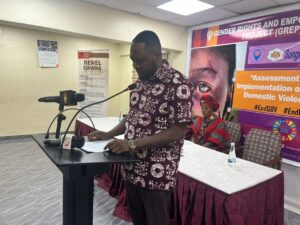
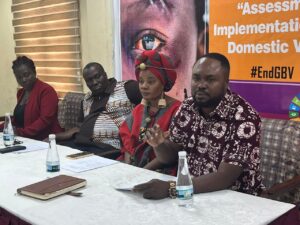
The Renel Ghana Foundation, in partnership with Songtaba and with funding support from the UN Trust Fund to End Violence against Women, has renewed calls for stronger implementation of Ghana’s Domestic Violence Act, 2007 (Act 732). The appeal was made during a press briefing led by Mr. Nelson Richardson-Mandela, Executive Director of the Foundation.
The Foundation’s call follows disturbing findings from the Gender Rights and Empowerment Project (G-REP), which revealed persistent gaps in protecting women and girls from gender-based violence (GBV). Data from the 2022 Ghana Demographic and Health Survey shows that intimate partner violence (IPV) remains a major concern, with prevalence rates of 53.4% in the Savannah Region and 44% in the Central Region. In addition, over 1,000 older women in northern Ghana remain banished to “witch camps,” where studies show that nearly all experience severe social and psychological distress.
To address these challenges, G-REP is piloting integrated one-stop centers offering survivors legal, psychosocial, and medical support. Early results indicate that these centers significantly improve access to timely and comprehensive services. The Foundation urged government to scale up this model nationwide.
Mr. Richardson-Mandela emphasized that weak institutional support, limited funding, and poor awareness of the Domestic Violence Act continue to undermine its effectiveness. He noted that crucial protective measures, such as protection and occupation orders, are often underutilized due to low awareness among police, social workers, and judicial staff. The Domestic Violence Victims Support Fund, intended to provide financial and material aid to survivors, also remains underfunded and largely inactive.
Cultural stigma and patriarchal norms further entrench the problem, discouraging survivors from reporting abuse. Survivors also face hurdles such as delayed police responses, prolonged prosecutions, and insensitive handling of cases by officials, eroding trust in state systems.
The Foundation outlined urgent demands, including:
Mandatory continuous training for police, social workers, and judicial officers on survivor-centered responses.
Strengthening the Domestic Violence Management Board with technical expertise and resources.
Nationwide awareness campaigns targeting professionals and communities on the Act’s provisions.
Expedited prosecution of domestic violence cases and stronger accountability systems.
Institutionalizing and resourcing the one-stop center model across the country.
“Ghana cannot afford to leave survivors at risk due to institutional inertia and underinvestment,” Mr. Richardson-Mandela said. “Every survivor deserves safety, dignity, and justice. The time to act is now.”
The Renel Ghana Foundation has urged Parliament, government ministries, district assemblies, traditional authorities, and civil society to collaborate in ensuring that the Domestic Violence Act fulfills its promise of protection and empowerment for all women and girls.

