
From a 3,564-project backlog to new construction in all 16 regions, expanded scholarships and new financing partnerships, Paul Adjei’s tenure at GETFund is putting execution, access and accountability at the centre of Ghana’s education infrastructure agenda.
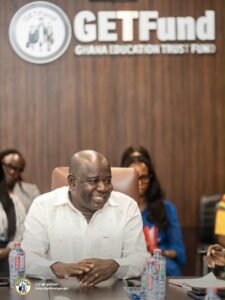
When Paul Adjei assumed responsibility for the Ghana Education Trust Fund in January 2025, he inherited more than a budget to administer. He inherited a backlog.
There were 3,564 project units on the books—projects started over the years, some waiting for funding, others requiring fresh assessment before they could be completed. At the same time, schools and tertiary institutions across the country continued to face shortages of classrooms, accommodation, sanitation facilities, laboratories and other essential infrastructure.
Adjei’s response was to reset the Fund around a straightforward proposition: finish what can be finished, respond to the most urgent needs, widen access to opportunity and bring new partners into the financing of education. Read Also: COCAINE IN GHANA: WHICH GOVERNMENT HAS NOT BEEN TOUCHED BY THE EVIL?-1
Twenty months into that agenda, the scale of activity is significant.
The money is moving
Between January 2025 and September 2026, GETFund paid GH¢11.573 billion towards education projects and Free SHS.
Of that amount, GH¢6.607 billion went into projects: GH¢3.523 billion for secondary education, GH¢2.223 billion for tertiary education and GH¢860.85 million for basic education. http://ghanaweb.com
Another GH¢4.966 billion went towards Free SHS.
The pace has also accelerated.
By 25 September 2026, Free SHS payments for the year had reached GH¢3.155 billion—GH¢1.344 billion more than the entire amount paid in 2025.
Project payments for 2026 stood at GH¢3.098 billion.
These figures tell an important part of the Resetting Agenda story: under Adjei’s administration, GETFund has been positioned not simply as a fund that approves projects, but as an institution focused on moving resources into schools and programmes.
Opening more doors for students
The reset has not been confined to bricks and mortar.
For the 2025/26 academic year, GETFund awarded 6,904 local scholarships. Importantly, that figure excludes first-year students covered under the No Fees Stress Policy. It therefore represents additional scholarship support rather than a relabelling of existing assistance.
The international scholarship programme has expanded even more sharply.
Awards increased from 260 in 2025/26 to 478 in 2026/27—an increase of 218 students, or 83.8 percent.
The achievement is particularly notable because the scholarship budget barely moved.
The difference came through negotiation.
GETFund’s Scholarship Team secured deeper fee discounts from partner universities, including Leicester, Bradford, Nottingham, Manchester, Southampton, Durham, Sheffield, Aberdeen and Queen’s Belfast. The result is that substantially more students can be supported from broadly the same financial envelope.
That is the Resetting Agenda in another form: stretching existing resources further.
The Fund has also introduced the Professor John Evans Atta Mills Scholarship with Temple University, targeting outstanding law students.
Beyond traditional academic scholarships, support has expanded into capacity-building for institutions including the Military, Ghana National Fire Service, Ghana Prisons Service, Judicial Service, Parliament and cybersecurity agencies.
The objective is broader than funding individual students. It is investment in skills, institutions and national capacity.
A footprint in all 16 regions
Perhaps the clearest expression of the Resetting Agenda is visible on the ground.
Since 2025, GETFund has initiated 2,031 targeted emergency projects across the country.
They include:
• 1,039 secondary-school projects
• 650 basic-school projects
• 342 tertiary-institution projects
And every one of Ghana’s 16 regions is covered.
The regional distribution reflects where infrastructure pressure has been identified. Volta accounts for 306 projects, followed by Northern with 191 and Ashanti with 188.
The projects themselves respond to some of the most practical constraints facing schools.
There are 561 staff accommodation projects, 492 classroom blocks and 313 student accommodation projects. Together, these account for roughly two-thirds of the portfolio.
Another 255 projects involve toilets and washrooms, while the remainder include dining halls, libraries, laboratories, assembly halls and TVET centres.
This is infrastructure designed around use: classrooms for teaching, accommodation for students and teachers, sanitation for healthier learning environments and specialised facilities for technical and vocational education.
Tackling the old backlog while building the new
The new projects are only one side of Adjei’s assignment.
The inherited portfolio remains a central part of the Resetting Agenda.
By December 2025, GETFund was undertaking revaluation and cost-to-completion assessments to establish what it would actually take to complete older projects. Management expects approximately 300 inherited projects to be completed by December 2026.
That is an important shift from simply carrying unfinished projects on a ledger to establishing what each project needs to reach completion.
The message is clear: the backlog is not being ignored; it is being costed, prioritised and brought back into an active delivery programme.
A candid record of what remains
The strongest case for the Resetting Agenda is not that every project is already complete. It is that the administration has been unusually clear about where implementation stands.
As of 18 September 2026, 13 of the 2,031 new projects were complete, while another 230 had reached at least 40 percent completion.
The remaining 1,801 projects—about 89 percent—were below the 40 percent mark.
That is a substantial unfinished workload.
But the chronology matters.
Commitment authorisation for the 2025 programme arrived in August 2025. Procurement was largely completed by February 2026, while sites were handed over by April. Most of the projects had therefore been under construction for less than six months as of September 2026.
The next challenge is consequently clear: turn project starts into sustained construction and construction into completed, usable facilities.
That puts the spotlight on contractor mobilisation, work programmes, certification, cash flow and the early identification of stalled projects.
In other words, the Resetting Agenda is entering its delivery test.
Bringing new partners to the table
Adjei’s administration has also sought to broaden the way education infrastructure is financed.
Through the Education Financing and Partnership Initiative (EFPI), companies, banks, alumni groups and individuals can support verified education priorities through a more structured mechanism.
So far, the initiative has documented GH¢27.69 million in contributions.
Saka Homes has made the largest contribution, valued at GH¢18.7 million, towards a two-storey student dormitory.
JOBerg Ghana Limited is constructing a six-unit classroom block and a six-unit toilet facility at Afife R C Primary School.
West One has supplied 1,000 mono desks. FuelTrade and Zenith Bank have each provided GH¢1 million in cash.
IPMC has pledged five computer laboratories, 200 solar streetlights and an incinerator, while Jay Kay, Aki Ola Publications, GCB Bank and others have provided books, furniture and other educational materials.
There are also six prospective partners whose stated intentions are valued at GH¢531 million.
GETFund has appropriately distinguished between money actually received, goods delivered, projects under construction and pledges.
That distinction matters.
The ambition is not merely to announce partnerships, but to build a system in which partners can see where their contribution went and what it delivered.
From procurement to classrooms
The scale of procurement under the Resetting Agenda is equally striking.
Since 2025, procurement has covered approximately 13.8 million items.
These include:
• 4.4 million exercise books
• 1.65 million notebooks
• 1.7 million school registers
• 550,000 graph books
• 550,000 PE kits
• 171,666 mathematics sets
• 307,691 basic-school uniforms
• 276,000 mono desks
• 1,136,361 sanitary pads
• 1,403 solar charging cabinets for tablets
• 666 STEM sets
Approximately three million of the total items are sensitisation flyers.
Some procurement remains in progress, including 181,140 mono desks, 16,919 two-in-one bunk beds, 48 Hyundai Country buses and 44 Toyota Hilux vehicles.
A borehole programme for selected schools is also awaiting confirmation of quantities.
The figures show an administration attempting to connect funding decisions with the everyday materials that make schools function.
Building for the day after the ribbon-cutting
Perhaps one of the most consequential changes in thinking is what happens after a project is completed.
For years, the completion and handover of a building could effectively mark the end of the process. But a school building is only valuable if it remains usable.
GETFund’s three Project Monitoring Offices, established in 2020, have strengthened oversight from project initiation through completion.
The proposed Project Operationalisation, Maintenance and Standards initiative takes that philosophy further.
It introduces minimum requirements around commissioning, occupancy, preventive maintenance, asset records and post-contract evaluation.
The principle is simple but important:
A classroom block financed today should still be functioning as a classroom block ten years from now.
That moves the conversation from construction alone to the full life cycle of public investment.
The next test
The Resetting Agenda now faces a decisive phase.
GETFund’s priorities through December 2026 include funding and scheduling inherited projects, with the approximately 300 expected completions tied to actual delivery dates.
The Fund also intends to move the 1,801 early-stage projects into sustained construction, supported by monthly exception reporting.
Other priorities include maintaining a rolling cash-flow forecast for certificates, procurement and Free SHS; adopting the asset-maintenance standard; giving EFPI partners verified progress reports; reporting scholarship outcomes by institution, programme and completion rate; and expanding procurement reporting to include contract values, suppliers and delivery dates.
That agenda is ambitious because the unfinished work is substantial.
But it is also measurable.
A reset measured in delivery
Paul Adjei’s tenure at GETFund can therefore be understood through a series of concrete shifts: more money moving into education, more students receiving scholarship support, more projects reaching communities, all 16 regions covered, more private partners brought into education financing and greater attention to what happens after construction.
The numbers do not suggest that the work is finished. They show something more useful: the scale of the reset and the size of the task still ahead.
From the 3,564-project inheritance to 2,031 new targeted interventions; from 6,904 local scholarships to an 83.8 percent increase in international awards; from billions committed to education to new partnerships designed to mobilise additional resources, the administration has sought to make GETFund more active, more expansive and more focused on execution.
The defining question now is no longer simply how many projects have been announced.
It is how many will be completed, commissioned, occupied and maintained.
That is the next chapter of the Resetting Agenda—and the measure by which the work already begun under Paul Adjei will ultimately be judged.

