
Fumesua, Kumasi – Ghana, September, 2026 (CSIR-CRI)) – Scientists from Ghana and the United Kingdom gathered at the CSIR-Crops Research Institute (CSIR-CRI) for the start of Geophysics for Climate-Smart Agriculture in Africa, a two-year research project hosted at the institute’s Multicultural Technology Park.
The project is funded by UK Research and Innovation through the Science and Technology Facilities Council, and runs from April 2026 to March 2028. It is led by the British Geological Survey, working with CSIR-CRI, the Kwame Nkrumah University of Science and Technology (KNUST), the Alliance of Bioversity International and CIAT, and the University of Nottingham.
Burning crop residues releases pollutants that warm the climate quickly and harm the air people breathe. A new research partnership at Fumesua is testing what happens when farmers leave that material on the soil instead — using technology borrowed from geology to see underground.
A park built to tackle the fast movers
The new project joins a platform created for exactly this purpose. The Multicultural Technology Park (MTP) at Fumesua was established by the ACE4ES Consortium, with support from the Climate and Clean Air Coalition, to advance sustainable agricultural innovation within an agroecology framework and to reduce greenhouse gas emissions and pollutants from farming. Read Also: Abass Osabutey Banks on Experience to Lead NDC Organization-1
Two of its targets — methane and black carbon — belong to a group known as short-lived climate pollutants. They do not linger in the atmosphere for centuries as carbon dioxide does. Methane largely disappears within about a decade; black carbon, the soot released by incomplete burning, falls out within days or weeks. But while they are up there, they are powerful, and black carbon settles on surfaces, darkening them and causing further warming.
That short life is the opportunity. Cutting these pollutants slows warming within years rather than generations, and because they also damage lungs and crops, the health and food-security benefits arrive immediately and locally. The park also targets nitrous oxide, which is long-lived, exceptionally potent, and largely emitted from soils and fertilizer.
Within the park, the residue management program pursues two connected goals: better soil health and an end to burning crop residues in the field. Burning is quick and cheap for the farmer, and it is also one of agriculture’s most direct sources of black carbon. Leaving residues on the ground is widely recommended instead. Proving what it does, and what it costs the farmer, is harder.
The farmer’s dilemma
Dr. Eric Owusu Danquah, Principal Research Scientist at CSIR-CRI, set out the problem at the meeting. Residues are not spare material lying idle. The same maize stalks that would protect and feed the soil are also dry-season fodder that keeps a family’s goats and sheep alive. A farmer with two acres cannot easily forgo feed today while waiting several seasons for soil benefits to accumulate.
What the extension system needs, he argued, is evidence that measures the trade-off honestly, rather than advice that assumes one side of it. https://dailydemocratnewsonline.com/
Seeing underground
The difficulty is that the most important effects happen where nobody can see them. Does mulch really hold water in the soil for longer? How deep does rainfall reach before it evaporates? And do the wetter patches also become places where soil microbes quietly release nitrous oxide — trading one climate problem for another?
Answering those questions has traditionally meant digging, which destroys the thing being measured and yields only a few scattered readings.
The project’s approach avoids digging altogether. A small, harmless electrical current is passed through the soil between buried sensors. Wet soil carries the current easily; dry soil resists it. Repeated over and over, the measurement builds something close to a moving picture of water in the ground: where it goes after rain, how long it stays, and how a mulched plot differs from a bare one.
The instruments will be built in Ghana. KNUST is assembling them from an open-source, low-cost design, and they will remain at the CSIR-CRI-hosted MTP at Fumesua under Ghanaian ownership when the project ends, operated by staff trained to maintain and repair them.
What is being tested
The field experiment compares maize grown with three legume partners — cowpea, groundnut, and mucuna — across three levels of residue retention: none, half, and all. Each combination is repeated across three parts of the field so that treatment effects can be separated from differences in the land itself.
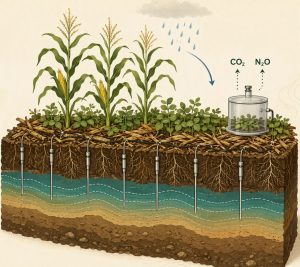
Alongside the soil-water imaging, chambers placed on the ground will capture the gases emitted from it. Measurements of methane and carbon dioxide begin this season. Nitrous oxide, which requires a more sensitive instrument arriving later, follows in the second season — allowing the team to first establish which conditions produce emissions, then test whether that understanding genuinely predicts them.
Much of the second day was spent, at the insistence of Professor Murray Lark of the University of Nottingham, writing down clear predictions before choosing what to measure. Groups drafted statements specific enough to be proved wrong, then worked out what evidence would settle each one.
Building people, not only data
The grant behind the project is aimed at training the next generation of physicists, and the meeting reflected that. Sixteen early-career researchers from the partner institutions were assigned to working groups carrying real responsibilities in planning, data management and publication. Training includes hands-on fieldwork at Fumesua, a residential workshop in the UK, and online courses. A separate session addressed the participation of women, both as researchers within the consortium and as farmers and stakeholders with equal claim to information and training.
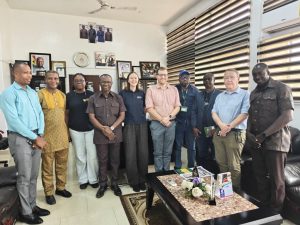
A stakeholder consultation workshop follows on 9 September at CSIR-CRI, bringing together farmers, extension officers, policymakers and development partners, with a field visit to see the instruments in the ground.
Burning clears the field in an afternoon, but the cost goes into the air and out of the soil. This project lets us show farmers what they get back when they leave the residue where it fell.” Said Dr. Kwaku Onwona-Hwesofour Asante, ACE4ES PI and CO-PI for the Ghana Agrogeophysics Program.
Story by:
Nana Yaw Reuben

