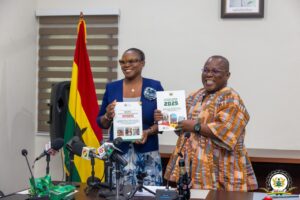
The National Development Planning Commission (NDPC) has reaffirmed its commitment to transparency, accountability and evidence-based policymaking as it engaged the media on the key findings of Ghana’s 2025 Annual Progress Report (APR), the final assessment of the implementation of the country’s current national development policy framework.
The media engagement was organised to provide journalists and stakeholders with an overview of the report’s findings, highlight Ghana’s development progress, and offer an opportunity for interaction with the Commission’s leadership ahead of the report’s official launch.
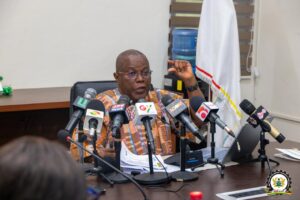
Addressing the gathering, the Chairman of the NDPC, Dr. Nii Moi Thompson, described the Annual Progress Report as one of the country’s most important accountability tools, stressing that it provides an objective assessment of national development performance and serves as a guide for future policy decisions.
He said the report fulfils the Commission’s constitutional mandate to monitor, evaluate and report on the implementation of national development policies, programmes and projects. Read Also: SafeBond Urges Cocoa Farmers to Prioritise Savings
“The report seeks to answer one fundamental question: Are national development policies improving the lives of the people?” he stated, noting that development should be measured by improvements in education, healthcare, employment, infrastructure, institutional effectiveness and opportunities available to citizens rather than the number of projects undertaken.
Dr. Thompson emphasised that the report is more than a collection of statistics, describing it as a national learning instrument that enables government to identify successful interventions, address implementation gaps and improve policy outcomes.
He observed that while the report celebrates achievements made over the reporting period, it also highlights areas requiring greater policy attention, insisting that honest assessment remains essential for effective national planning.
According to him, every development indicator reflects the lived experiences of individuals, families and communities, making it important to interpret the data within the broader context of improving citizens’ well-being.
He also called on journalists to report the findings professionally, accurately and responsibly, describing the media as indispensable partners in promoting public accountability and informed national discourse. http://dailydemocratnewsonline.com
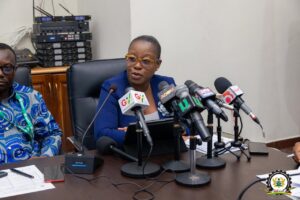
Director-General of the NDPC, Dr. Audrey Smock Amoah, said the media engagement was designed to ensure that journalists fully understand the contents of the report before its official publication.
She explained that the Commission recognises that development reports often contain complex data that can be misunderstood without adequate explanation and context.
Dr. Amoah noted that the report was compiled through a rigorous nationwide monitoring and evaluation process involving annual progress reports submitted by ministries, departments and agencies, metropolitan, municipal and district assemblies, regional coordinating councils, as well as official statistics from national institutions.
She said the Commission subjected the information to extensive verification, validation and cross-sectoral review before approving the final report to ensure that its conclusions accurately reflect Ghana’s development performance in 2025.
According to her, the report presents findings across multiple sectors, outlines implementation achievements, identifies emerging challenges, draws lessons from the reporting period and offers recommendations to strengthen future policy implementation.
She encouraged journalists and other stakeholders to actively engage with the evidence presented, stressing that the exercise was intended to promote informed public discourse based on facts rather than speculation.
Dr. Amoah described the Annual Progress Report as a learning instrument that enables the country to assess its performance, learn from experience and improve planning, implementation and monitoring of national development initiatives.
The Commission expressed confidence that the engagement would strengthen collaboration with the media and enhance public understanding of Ghana’s development performance through accurate, balanced and evidence-based reporting
 .

