Greater Accra Begins Action To Reclaim Waterways-1

Date:


The Greater Accra Regional Minister, Linda Obenewaa Akweley Ocloo, has announced a 21-day ultimatum for owners of structures situated within designated waterway buffer zones at Peshi Lagoon, Laboma, to remove their properties or face demolition by the Regional Security Council (RECSEC).
The directive forms part of intensified measures by the Greater Accra Regional Coordinating Council to reclaim waterways, restore natural water retention paths and address persistent flooding across the region.
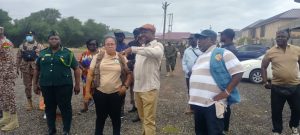
Speaking during an inspection and demolition exercise at Peshi Lagoon in the La Dadekotopon and Ledzokuku municipalities, the Regional Minister said structures found to have encroached on the designated buffer zones would have to be removed.
She explained that the decision followed concerns over increasing development along waterways, which has restricted the natural flow of rainwater and contributed to flooding in several communities.
“We want to get back that water,” the Minister said, stressing that the exercise was intended to create adequate buffers to allow stormwater to settle and gradually flow into the sea.
According to her, some of the structures had been identified during an earlier exercise, when their construction was still at foundation level, and owners had been cautioned against proceeding with development. Read Also: NYA Boss Champions Values, Patriotism Among Ghanaian Youth-1

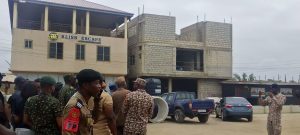
However, she said some developers had continued construction, with some allegedly working at night and rapidly putting up structures within a matter of days.
The Minister rejected suggestions that local assemblies had simply failed to enforce planning regulations, explaining that some assemblies had faced serious challenges in dealing with encroachers, particularly where enforcement officers encountered resistance.
She said the current exercise was being undertaken under a firm government directive and would continue until the affected waterways were properly restored.
The Regional Minister further disclosed that arrests would be made where necessary, adding that owners of illegal structures would be held responsible for the costs associated with their removal.
She stressed that government would not bear the financial burden of demolishing structures erected in violation of the law.
The Regional Political Coordinator at the Office of the President, Anthony Nkwenu, who accompanied the Minister, said the government’s immediate objective was to restore the water retention path, dredge heavily silted sections and remove boulders and other materials obstructing the waterway.
He said some sections had been heavily silted and that the obstruction of water flow had contributed to flooding, particularly following recent heavy rains.
Mr. Nkwenu explained that although authorities had the legal basis to remove structures without further notice where they had been erected without permits, government had opted to give affected property owners 21 days to voluntarily remove their structures.
He said the intervention would be carried out in phases, with engineers and relevant institutions working together to restore the waterways and improve the capacity of drainage infrastructure.
The Regional Minister said 48 engineers had been deployed to support the anti-flooding exercise, while the Hydrological Services and the Ministry responsible for Water Resources would also provide technical input, including recommendations on engineering works around affected bridges.
She emphasised that the operation would not be a one-day exercise, but a continuous intervention aimed at addressing the root causes of flooding in vulnerable communities.
The authorities also appealed to residents, property owners and the media to support the exercise, describing the restoration of waterways as a shared national responsibility.
The Minister maintained that the government’s objective was not to inconvenience residents but to prevent further encroachment and protect communities from the devastating consequences of flooding.
She urged residents to comply with the 21-day notice and avoid putting up structures in waterways and their designated buffer zones. http://ghanaweb.com
Share post:

Subscribe

Popular

More like this
Related

WHO Calls for Sustainable Funding for Medical Trust Fund

  The World Health Organization (WHO) has commended the Ghana Medical Trust Fund for its progress during its first year, describing the initiative as a significant step towards reducing financial hardship for Ghanaians living with chronic and high-cost diseases. Speaking on the first anniversary of the Ghana Medical Trust Fund, WHO Country Representative to Ghana, Dr. Fiona Braka, congratulated the government, the leadership of the Fund and the people of Ghana for what she described as significant progress since its establishment. Dr. Braka particularly acknowledged President John Dramani Mahama for the vision behind the Fund, saying the initiative was making a difference by helping vulnerable patients access treatment without being overwhelmed by the cost of care. She said the Fund was complementary to other government health initiatives, including the Free Primary Healthcare Initiative and the National Health Insurance Scheme (NHIS), with the various interventions designed to provide Ghanaians with access to healthcare at different levels. “Ultimately, the aim is to ensure that everyone accesses services regardless of where they are and what they are suffering from,” she said. Hope for patients with chronic diseases  According to Dr. Braka, the establishment of the Fund has brought renewed hope to vulnerable citizens who previously struggled to afford treatment for chronic and high-cost conditions. She cited cancer, diabetes, chronic kidney disease, cardiovascular diseases and stroke among conditions that could impose significant financial burdens on patients and their families. Beyond direct patient support, she said, the Fund was also investing in the broader health system through infrastructure development, medical equipment and the training of health professionals. “This fund is not just looking at patient support, but it's also looking at medical equipment, it's looking at the infrastructure, it's looking at the human resources or workforce capacities, and there's also the aspect of research,” Dr. Braka said. She noted that strengthening specialist healthcare required adequately trained doctors, nurses and other health professionals capable of managing complex and chronic conditions. Linking the healthcare system  The WHO representative also highlighted what she described as an emerging pathway linking Ghana's healthcare reforms. Under the model, patients would receive free primary healthcare at the primary level, benefit from the NHIS at the next level, and access specialised care through the Mahama CARES initiative, including the Ghana Medical Trust Fund, where necessary. Dr. Braka said the definition of this pathway represented an important development because patients should be able to move seamlessly between different levels of care depending on their medical needs. She cited the cardiac centre at the Korle Bu Teaching Hospital as an example of the Fund's emerging impact, recalling WHO's participation in its launch. “It was a moment of pride for everyone to see that we are actually seeing it coming to bear,” she said. WHO urges sustainable funding  Looking ahead, Dr. Braka urged stakeholders to focus on establishing sustainable financing arrangements for the Fund to ensure that its gains are maintained beyond its first year. She called for the institutionalization of funding arrangements, including protected budget lines, to provide the initiative with predictable and sustainable financing. “The sustainable component is extremely important,” she stressed. She also called for the expansion of the Fund's coverage to bring more patients into the financing mechanism and extend support beyond the diseases initially prioritized. Dr. Braka said there was a need to consider additional disease conditions as the Fund expanded, while ensuring that its operations remained integrated with Ghana's wider healthcare reforms. Ghana as a model for innovative health financing  The WHO representative expressed hope that Ghana's experience with the Fund could provide lessons for other countries seeking innovative ways to advance universal health coverage. She said effective implementation, transparent data and evidence demonstrating the Fund's impact would be important in showing whether the financing mechanism was reaching an increasing number of people and reducing financial hardship. “We know that we are all working towards universal health coverage, and Ghana is leading in many ways,” she said. Dr. Braka expressed optimism that Ghana could demonstrate to the African region and the wider world how innovative financing mechanisms could help close gaps in healthcare financing and advance universal health coverage. She reaffirmed WHO's commitment to supporting the initiative, saying the organisation had been involved from its inception and would continue working with the government to help translate its vision into tangible benefits for Ghanaians. “As WHO, we congratulate the Government of Ghana on this one-year milestone,” Dr. Braka said, adding that the organisation remained a committed partner in efforts to make the Fund sustainable and beneficial to more citizens.    

TEESSIDE UNIVERSITY GHANAIAN SOCIETY MAKES HISTORIC RETURN TO FRESHERS COMMUNITY DAY

  *Middlesbrough, UK -* The Teesside University Ghana Society (TUGS)...

Opong-Fosu Pledges Stronger, United and Future-Ready NDC

Hon. Dr. Akwasi Opong-Fosu has officially declared his intention...

Experts Demand Urgent Reforms to Rescue ECOWAS

  The future of the Economic Community of West African...