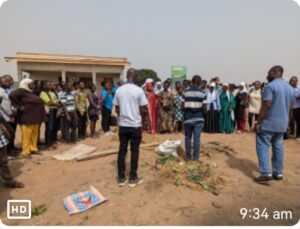
The Agroecology and Circular Economy for Ecosystem Services (ACE4ES) project hosted a transformative training session for young people, equipping them with critical knowledge and skills in sustainable agriculture and natural resource management. Organized by Peasant Farmers Association of Ghana and CSIR-Crops Research Institute and held at the Multicultural Technology Park, the program combined theoretical insights with hands-on demonstrations, inspiring participants to champion climate action and ecosystem preservation.
The training featured interactive sessions facilitated by experts in agroecology, climate-smart agriculture, and integrated pest management. Participants gained practical experience in composting, liquid fertilizer production, and organic pesticide preparation. The training also emphasized leveraging social media and online branding to advocate for sustainable practices effectively.
The day’s facilitators included:
Dr. Kwaku Onwona-Hwesofour Asante, who introduced agroecology, circular economy principles, and circular economy infrastructures. Read Also: Nordiq Hygiene Care Industry Manufactures Sanitary Pads Locally
Dr. Clement Oppong Peprah, who discussed climate-smart agricultural technologies.
Dr. Joseph Adomako, who led the session on organic pesticide production.
Mr. Emmanuel Adu, who conducted a practical workshop on composting and liquid fertilizer production.
Participants enthusiastically shared their experiences, reflecting on the value of the training. Michael Asamoah, a graduate of Kwame Nkrumah University of Science and Technology, shared his testimonial:
“Earlier today, I attended an intensive training session organized by CSIR-CRI on Sustainable Agriculture and Capacity Building. The knowledge shared, particularly on agroecology and climate-smart practices, was enlightening. I now feel equipped to implement these practices for societal development.”
Such testimonies underscore the transformative potential of the ACE4ES initiative.
A key highlight of the event was the practical demonstration sessions. Participants rotated through three hands-on stations:
Composting and Liquid Fertilizer Production: Participants learned how to create organic fertilizers to improve soil health sustainably. http://www.ghanaweb.com
Organic Pesticide Production: Facilitators showcased how to use botanicals like neem and bitter leaves for integrated pest management.
Circular Economy Infrastructural Installations: Participants toured the Multicultural Technology Park, learning about infrastructure designed to support agroecological practices.
A Pathway to Climate Action
The ACE4ES project is committed to driving climate action and ecosystem preservation through education and stakeholder engagement. By equipping youth with the tools to implement sustainable practices, the project is fostering a new generation of agricultural leaders dedicated to a sustainable and resilient future.
The event was made possible through the generous funding support of the Climate and Clean Air Coalition (CCAC), hosted by the United Nations Environment Programme (UNEP).