
ISA, Jospong Partner to Solarise 36 Waste Plants

Date:


The International Solar Alliance (ISA) has presented a comprehensive solarisation roadmap to the Jospong Group of Companies (JGC) at the ongoing 31st United Nations Climate Change Conference (COP31) in Antalya, Türkiye, paving the way for a proposed strategic partnership to accelerate renewable energy deployment, promote green investments and strengthen Africa’s transition towards carbon neutrality.

The proposed collaboration seeks to leverage the technical expertise and financing opportunities of the ISA alongside Jospong Group’s extensive operational presence across Africa to develop sustainable solar energy solutions for industrial operations, agriculture and communities.

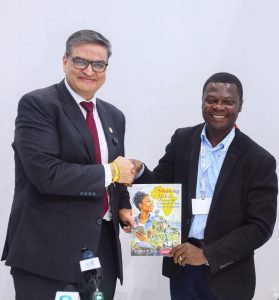
Presenting the roadmap, the Director-General of the International Solar Alliance, Mr. Ashish Khanna, emphasised the urgent need to address Africa’s energy access challenges through innovative financing, strategic partnerships, technology transfer and local capacity development.

He noted that approximately 600 million Africans still lack access to electricity, despite the continent’s enormous renewable energy potential.

Africa, he indicated, accounts for only about 1% of installed global solar photovoltaic capacity, while receiving approximately US$9 billion of the US$521 billion invested in renewable energy globally in 2024.

These disparities, he explained, demonstrate the need for stronger partnerships between governments, development institutions and private sector operators to unlock Africa’s solar energy potential.

The ISA, an intergovernmental organisation comprising 116 member and signatory countries, is pursuing an ambitious target of mobilising US$1 trillion in solar investments by 2030 under its implementation-driven agenda.

*Four Strategic Areas of Collaboration*

The proposed ISA-Jospong partnership focuses on four major areas designed to accelerate solar energy adoption and sustainable development across Africa.

The first component involves establishing a dedicated Solar Academy to equip young Africans with practical skills in solar technology, installation, maintenance and renewable energy systems.

The initiative is expected to promote technical expertise, create green employment opportunities and develop a skilled workforce capable of supporting Africa’s expanding renewable energy sector.

The second component seeks to unlock climate-smart agricultural financing to support the deployment of solar-powered irrigation pumps, particularly for smallholder farmers.

The initiative would help reduce dependence on conventional energy sources, improve agricultural productivity and strengthen food security.

The ISA has identified solar-powered irrigation as a major opportunity for Africa, where only about 4% of cultivated land is irrigated, compared with 37% in Asia and 14% in Latin America.

The third component focuses on facilitating the transfer of modern solar technologies, technical knowledge and international best practices to strengthen local expertise and support renewable energy innovation.

This would enable Jospong and other African institutions to adopt cost-effective solar solutions while building the technical capacity required for sustainable operations.

A major highlight of the proposed partnership is the solarisation of Jospong Group’s 36 waste treatment plants in Ghana, which would serve as a flagship project for subsequent expansion into other African markets.

The initiative forms part of Jospong’s broader green transition strategy, which includes plans to convert approximately 1,000 waste collection trucks from diesel to electric power, supported by solar mini-grids, charging stations and energy storage infrastructure.

The proposed solarisation programme is expected to reduce operational dependence on fossil fuels, improve energy security and lower the carbon footprint of the Group’s waste management operations.

*Jospong Reaffirms Commitment to Improving Energy Management*

Speaking during the engagement, the General Manager of the Jospong Green Transition Office, Dr. Ing. Glenn Kwabenah Gyimah, welcomed the roadmap and reaffirmed the Group’s readiness to work with the International Solar Alliance to advance renewable energy investments across Africa.

“Jospong stands ready to begin with solarising our 36 plants in Ghana and to extend this model to our Africa projects. This reflects our strong commitment to low-carbon project development and to minimising the footprint of our products and services as we drive towards our carbon neutrality agenda,” he stated.

Dr. Gyimah emphasised that the proposed partnership represents a significant opportunity to integrate renewable energy into Jospong’s operations while supporting Africa’s wider climate action and sustainable development objectives.

He noted that the Group’s growing investments in green technologies, waste recovery, recycling and sustainable infrastructure provide a strong foundation for the adoption of solar-powered industrial systems.

Jospong’s green transition efforts have also attracted international recognition through carbon financing initiatives.

At COP28, the Group secured Swiss Government authorisation for internationally transferred mitigation outcomes from its composting facilities, with an estimated value of US$20 million by 2030.

The initiative is expected to support further investments in sustainable infrastructure and community development.

*Expanding Renewable Energy Solutions Across Africa*

The proposed collaboration is expected to support Jospong’s expanding environmental services and infrastructure operations in African countries, including Nigeria, Uganda, Kenya, Tanzania, Ethiopia, Guinea and Liberia.

It also aligns with the ISA’s Country Partnership Framework, through which the alliance works with participating countries to accelerate solar investments and strengthen institutional capacity.

Ghana signed its Country Partnership Framework with the ISA in September 2025, identifying solar rooftops, community mini-grids, agricultural applications and capacity development as priority areas.

The engagement at COP31 therefore presents an opportunity to translate these commitments into practical private sector-led projects with measurable environmental, social and economic benefits.

With Africa facing persistent electricity access challenges despite its abundant solar resources, the proposed ISA-Jospong partnership could provide a replicable model for integrating renewable energy into industrial operations, municipal services and agricultural development.

For the Jospong Group, the roadmap represents another significant step towards achieving its carbon neutrality ambitions while contributing to Africa’s clean energy transition through innovation, strategic partnerships and sustainable investments

.

Share post:

Subscribe

Popular

More like this
Related

Government Backs Ekumfi to End Juice Shortages

Story by Elikem Desewu Ghanaian families, distributors and street retailers excited about 2027 budget as Ekumfi Juice shortages could become a thing of the past   Excise duty exemptions, US$3 billion agricultural investment, contract farming, affordable finance and export incentives open a new chapter for Ghana's fruit processing industry.  Ghana's 2027 Budget presented by the minister of finance, Dr Cassiel Ato Forson has named Ekumfi for commercial contract farming and pineapple outgrower development, a move that could end the irregular supply of Ekumfi Juice that has frustrated families, distributors, wholesalers and street retailers. Under the Feed-the-Industry Programme, Government explicitly identifies Ekumfi for implementation of the National Agribusiness Policy. The Budget also provides for training 200 youth-led agribusinesses and identifies the pineapple outgrower model as a way to secure steady raw-material supplies for factories. The decision has been widely welcomed. In interviews, industry experts, traders and ordinary consumers expressed joy and confidence in the Finance Minister's initiative, saying it will help boost the production of Ekumfi Juice. "Customers ask for Ekumfi every week, and most times we have to tell them it is finished," said Enock Ansah, a wholesaler at Makola Market. "If the farmers can supply the factory steadily, we will finally have it on our shelves all year round." The measure goes to the heart of the company's supply problem. Ekumfi Fruits & Juices Limited has taken its pineapple juice as far as Walmart's online marketplace in the United States, yet it has struggled to keep shelves at home stocked. Organized contract farming would let farmers produce under predictable purchasing arrangements while processors gain greater certainty over raw materials. With effective financing, it could improve factory utilization and reduce the interruptions behind shortages. Other Budget measures strengthen the case. Locally produced fruit juices will be exempted under the revised Excise Sliding Scale framework. For Ekumfi and other local processors, this should improve competitiveness, make room for more affordable consumer prices and lift demand for Ghanaian pineapples, citrus and other fruits. Actual tax savings will depend on product classifications and implementation rules. Government also proposes US$3 billion under the commercial agriculture pillar of the New Economy Programme. Its farm-to-market approach links land, irrigation, planting materials, mechanization, anchor farms and outgrowers to storage, processing, packaging, transport, retail and exports. For Ekumfi and its partners, this could support expanded pineapple and citrus plantations, although the US$3 billion is a national envelope, not a direct allocation to the company.   On financing, the Budget proposes expanding productive credit through Development Bank Ghana, Ghana EXIM Bank and participating financial institutions, using credit guarantees, equipment leasing, export finance and patient capital. Across the Ekumfi value chain, farmers need money for land preparation, seedlings, inputs and harvesting; factories need working capital to buy raw materials and fulfil orders; and exporters need funding for packaging, shipping, overseas inventory and distribution. Government further proposes reviewing Chapter 98 of the Customs Tariff Schedule, which grants concessionary duty treatment for selected raw materials, machinery and industrial inputs. The review aims to clarify eligibility and ensure concessions support genuine industrial production. Qualifying fruit-processing equipment may benefit, but the Budget does not grant automatic duty-free treatment to every packaging material or machine. Import duty and VAT exemptions for solar panels and batteries will also help irrigation schemes, processing plants, cold storage and distribution operations cut energy costs and improve power reliability. To widen international market access, the Budget plans to link agribusinesses to global buyers, promote new Export Processing Zones and support Made-in-Ghana products through Trade Houses in London and Philadelphia. Government also proposes certifying 100 exporters under AfCFTA Rules of Origin, placing 20 firms in the AfCFTA Guided Trade Initiative and cutting cargo clearance times by 15 percent. For Ekumfi Juice, the task is to move beyond an online listing to regular international supply. Ekumfi Pure Pineapple Juice is listed on Walmart.com, and its US marketplace seller, Ekumfi Fruits and Juices LLC, is reported to have attained Pro Seller status, although this has not been independently verified from Walmart's records. The wider distribution chain also stands to gain. The Budget notes that the VAT Act, 2025 introduced a reduced effective VAT rate and a harmonized regime. Under it, qualifying micro and small enterprises with annual turnover below GH¢750,000 do not have to register for VAT, freeing small traders and retailers to put more resources into stock and growth. The real achievement will not simply be getting Ekumfi Juice onto Walmart.com, but keeping it consistently available in Ghanaian shops and international distribution channels. To that end, Ekumfi Fruits & Juices, Crop Estates, Central Citrus Processing and other partners are targeting over 20,000 direct, indirect and induced jobs and livelihood opportunities through an integrated three-year expansion programme. It would link plantations, outgrowers, factories, packaging, warehousing, transport, retail and exports. The target is subject to financing, investment execution and market growth. The opportunity extends beyond conventional juice into fortified juices, functional teas, fruit concentrates, powders and fermented beverages. An illustrative national ambition of US$7 billion in annual high-value agribusiness revenue would require substantial investment, product innovation, international certification and export-market development. Against one industry forecast valuing the global functional foods and beverages market at US$591.7 billion by 2030, that target would equal roughly 1.18 percent of the market. Nationally, the Budget sets out integrated development across rice, sugar, poultry, maize and soyabean, aquaculture, oil palm, vegetables and cocoa value addition. This includes about 125,000 jobs from rice development hubs and more than 250,000 potential jobs from oil palm. Together with processing and logistics, these could underpin an ambition of over 800,000 jobs and livelihood opportunities, though this is a broad development goal rather than an official forecast. The challenge now is to turn Budget provisions into financing agreements, farming contracts, working factories, consistent product availability and measurable jobs. For Ghanaian families, distributors and street retailers, the greatest benefit will be seeing Ekumfi Juice regularly on shop shelves. For farmers, it will be dependable markets. For young people, jobs and businesses. And for Ghana, a stronger manufacturing and export economy. From a small community in Ghana to Walmart pro seller, Ekumfi and partners target over 20000 jobs in three years as Ghana pursues US$7 billion annual agribusiness opportunity.    

UFO Pushes for New Ministry to Strengthen National Peace

The Universal Friendship Organisation (UFO) has called on the...

GRA Busts Smuggling Attempt at Techiman Checkpoint

  The Customs Division of the Ghana Revenue Authority (GRA)...

Russia-Africa Summit Charts New Path for Shared Prosperity

  The Third Russia-Africa Summit under the motto “For Peace,...